 Road managers
 Accessibility tools


Queensland Class 4 Tow Truck Permit-Based Scheme
Queensland Class 4 Tow Truck Permit-Based Scheme
National
Heavy
Vehicle
Regulator
Introduction
The Department of Transport and Main Roads (TMR) in collaboration with industry and the National Heavy Vehicle Regulator (NHVR), has developed the Queensland Class 4 Tow Truck Permit-Based Scheme (the Scheme).
The Scheme allows operators of Class 4 tow trucks to apply to the NHVR for a Scheme permit that provides exemptions to exceed the prescribed mass and dimension limits set by the National Heavy Vehicle (Mass, Dimension, and Loading) Regulations (MDL Regulations).
The Scheme applies to class 4 tow trucks that have either an over-lift or under-lift lifting device.
To operate under the Scheme, operators must possess a current NHVR Scheme permit and comply with the Scheme conditions.
Eligible Class 4 heavy tow trucks under the Scheme?
A Class 4 tow truck is defined by Vehicle Standard (Australian Design Rule 44 – Specific Purpose Vehicle Requirements) 2006.
The tow truck must have a GCM of at least 25t and fitted with:
- a dual-tyred, tandem or tri-axle, drive axle group; and
- a power-operated winch; and
- air brake facilities for connecting to towed vehicles; and
- a crane (over-lift) or hoist (under-lift) that has a safe working load of at least 5t.
A tow truck that complies with this section is an eligible tow truck.
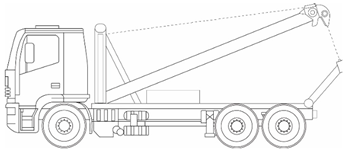
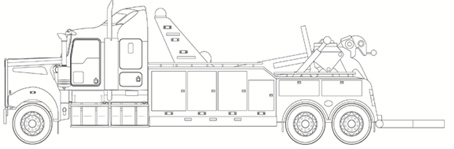
Examples of an over or under lift tow truck are shown in Figure 1 and Figure 2.
Note
- Drive axle groups that contain an axle with single tyres are not permitted by ADR44 to operate as a tow truck.
- Drive axle groups that contain an axle with single tyres are not eligible under this policy and require special assessment and approval.
Types of towing purposes
Under the Scheme, an eligible tow truck can operate under three towing purposes outlined in Table 1.
Each towing purpose has specific exemptions and operates in conjunction with the following Scheme conditions:
- Approved towed vehicles, components and combinations
- Scheme dimension conditions
- Scheme mass conditions
- Scheme operating conditions
- Area of operation.
| Option | Purpose of use | Definition of purpose |
|---|---|---|
| A | Unladen | When the tow truck is travelling unladen (without a load). |
| B | Towing between depots and a location. |
The towing of a single unladen vehicle or component that is disabled, broken down or crash damaged:
|
| C | Towing to clear a road or road related area. |
The towing of a vehicle, component or combination, from a road or road-related area that is:
|
Approved towed vehicles, components, and combinations
Under the Scheme, an eligible tow truck used for an approved towing purpose in Table 1 is permitted to tow a vehicle, component or combination in Table 2.
For instance, an eligible tow truck towing between a depot and a repairer is allowed to tow a single vehicle or component, which corresponds to option B in both Table 1 and Table 2.
A towed vehicle, combination or component described in Table 2 must:
- comply with the MDL Regulation, or
- be approved to operate under a current NHVR:
- exemption permit (Vehicle standards, Access Permit or PBS Vehicle Approval), or
- notice issued under the Heavy Vehicle National Law (HVNL).
| Option | Purpose of use |
|---|---|
| A |
|
| B |
For example: a prime mover only, or a trailer, or a bus. |
| C |
For example: a prime mover only, or a trailer, or a prime mover towing a trailer combination. |
|
Note:
|
|
Scheme dimension conditions
Under the Scheme, eligible tow trucks are provided with three categories of dimension exemptions, tailored to the specific purpose of use outlined in Table 1.
- Option A. Unladen dimension limits.
- Option B. Dimension limits for towing between depots and a location.
- Option C. Dimension limits for towing to clear a road or road-related area.
Option A. Unladen dimension limits
An eligible tow truck when operating unladen (purpose of use option A) must not exceed a dimension limit in Table 3.
| Dimension | Maximum Dimension |
|---|---|
| Width |
|
| Length |
12.5m |
| Height |
4.3m |
Option B. Dimension limits for towing between depots and a location
When towing between depots and a location (purpose of use option B), the eligible tow truck and towed vehicle must not exceed a dimension limit in Table 4.
| Dimension | Maximum Dimension |
|---|---|
| Width |
|
| Length |
The length of the tow truck and the eligible vehicle or component listed in option B of Table 2. |
| Height |
Up to 5.0m subject to:
Where possible, flat towing should be used to limit the height of the towed vehicle. |
Option C. Dimension limits for towing to clear a road or road-related area
When towing to clear a road or road-related area (purpose of use option C), an eligible tow truck and towed vehicle, component, or combination must not exceed a dimension limit in Table 5.
| Dimension | Maximum dimension |
|---|---|
| Width |
|
| Length |
The length of the tow truck and the eligible vehicle, component or combination listed in option C in Table 2 is subject to the requirements for towing a combination greater than 20 meters in length. |
| Height |
5.0m subject to:
Where possible, flat towing should be used to limit the height of the towed vehicle. |
Flat towing
It is recommended that flat towing or the partial lifting of the towed vehicle's steering axle be employed whenever feasible and safe. These practices help reduce the heights of towed vehicles and axle loading for both the tow truck and the towed vehicle.
Scheme mass conditions
Under the Scheme, the mass limits must not exceed any of the following limits:
- Table 6 unladen mass limits
- Table 7 laden mass limits
- Table 8 Mass limits for axles (limited by tyre size)
- vehicle manufacturer ratings
- the mass limit on the permit.
Option A. Unladen mass limits
An eligible tow truck when operating unladen (purpose of use option A), must not exceed the lesser mass limit specified in Table 6 or Table 8.
| Type of axle or axle group | Maximum mass limit |
|---|---|
| Steer axle | 7.0t |
| Twinsteer (non-load sharing) | 10.0t |
| Twinsteer (load sharing) | 16.0t |
| Tandem drive | 16.5t |
| Triaxle drive | 20.0t |
Option B and C. Mass limits for towing vehicles between depots and a location or to clear a road or road-related area
An eligible tow truck must not exceed the lesser mass limit specified in Table 7 and Table 8 when towing:
- between depots and a location (purpose of use option B), or
- towing to clear a road or road-related area (purpose of use option C).
| Type of axle or axle group | Maximum mass limit |
|---|---|
| Steer axle | 7.0t |
| Twinsteer (non-load sharing) | 10.0t |
| Twinsteer (load sharing) | 16.0t |
| Tandem axle fitted with dual tyres, centre line axle spacing 1.2m to 1.35m | 20.0t |
| Tandem axle fitted with dual tyres, where the centre line axle spacing - at least 1.35m | 23.0t |
| Tri-axle group fitted with dual tyres where the centre lines of the axles are at least 1.20m but less than 1.35m. | 25.0t |
| Tri-axle group fitted with dual tyres where the centre lines of the axles are at least 1.35m apart. | 27.0t |
Tyre size mass limits
A single axle with tyre widths described in Column 1 of Table 8 must not exceed the mass limit stated in Column 2 (steer axle) or Column 3 (drive axle) of Table 8.
| Width of the narrowest tyre on the axle | Maximum mass limit - steer axle (2 tyres) | Maximum mass limit - drive axle (4 tyres) |
|---|---|---|
| 190mm to < 228mm | 4.5t | 9.0t |
| 228mm to < 254mm | 5.0t | 9.5t |
| 254mm to < 279mm | 6.0t | 10.0t |
| 279mm to < 305mm | 6.5t | 11.0t |
| 305mm to < 330mm | 7.0t | 12.0t |
| 330mm to < 356mm | 7.5t | 13.0t |
| ≥ 356mm | 8.0t | 14.0t |
Towed vehicle mass limits
The mass of the towed vehicle must not exceed any of the following limits:
- Those specified by the towed vehicle manufacturer,
- The prescribed mass limits applying to the towed vehicle,
- The limits set by the towed vehicle’s notice or permit under which it is operating.
To prevent exceeding the mass limits of the tow truck or the towed vehicle, the operator should consider:
- uncoupling a towed combination or
- unloading a loaded vehicle, or
- transporting the vehicle another way, instead of being towed.
Scheme operating conditions
Drivers licence requirement
The tow truck driver must hold:
- a heavy rigid class of licence to operate the eligible tow truck unladen, and
- the class of licence for the vehicle or combination being towed.
For example, if the eligible tow truck is towing a prime mover and semitrailer, the tow truck driver would need to hold a heavy combination class of licence.
Licence requirements under the Scheme are listed in Table 9.
| Licence class | Vehicles or combinations eligible to tow |
|---|---|
| Heavy Rigid (HR) | Unladen travel in the eligible tow truck |
| Heavy Rigid (HR) | Single vehicle, trailer or a vehicle towing a trailer with a maximum GVM of 9t |
| Heavy Combination (HC) | Vehicle towing a trailer with a GVM exceeding 9t or a prime mover towing one semitrailer |
| Multi-Combination (MC) | B-double or road train |
|
Note:
|
|
Tow truck registration
If you're planning to tow a trailer for a purpose not associated in the movement of abandoned, disabled, seized, or crash damaged vehicles, it must be registered in the appropriate registration category for combination.
A tow truck towing a trailer, except when transporting abandoned, disabled, seized or crash-damaged vehicles, is classified as operating as part of a combination. The appropriate registration category is determined by the number of axles and the GVM of the combination.
For example:
- If a vehicle has four axles and the trailer has three axles, the combination will have more than six axles and must be registered as a medium combination.
- If a heavy vehicle operates in two different categories (e.g., as a truck and as a medium combination), legislation requires it to be registered in the category that attracts the higher registration fee.
For more information on registration categories and the towing for a purpose not associated with the movement of abandoned, disabled, seized, or crash damaged vehicles, TMR encourages operators to contact the TMR Customer Service 13 23 80.
Speed limit
The maximum speed limit under the Scheme is shown in Table 10 unless a traffic sign or towed vehicle permit indicates a lower speed limit.
| Maximum speed limits | Maximum speed limit condition applies when towing |
|---|---|
| 80km/h | An oversize vehicle that is required to travel with a pilot or escort vehicle |
| 90km/h | All other vehicles, components and combinations |
Manufacturers ratings
Vehicle manufacturers and component ratings must not be exceeded.
All permit applications must include a letter from the manufacturer stating the front and rear axle group capacity, GVM and GCM of the vehicle.
Weigh bridge certificate
All permit applications must include a weigh bridge document that shows the individual mass of the front and rear axle groups.
Tow trucks are to be weighed in a ready to operate condition with full fuel tanks.
City peak hour travel time condition
An eligible tow truck must not tow a single vehicle, component or combination in a location on a day or time in Table 11.
If a vehicle becomes disabled, seized by police or involved in a crash during the city's peak hour travel time in a location mentioned in Table 11, the vehicle can be towed to the nearest suitable and safe location or a location as directed by a police officer to ensure the safe and efficient movement of traffic. A record must be kept of the directing police officer, and the directive should consider stated areas and routes, traffic flow, and the safety of others.
| Location | Day | Time |
|---|---|---|
|
Brisbane City Council excluding:
|
Monday to Friday |
Between the hours of:
|
| A Central Business District (CBD) of any city. | Monday to Friday |
Between the hours of:
|
Low visibility
Travel in low visibility by a laden truck is only permitted for disabled vehicles, seized by police or involved in a crash to clear a roadway (purpose of use option C), and should be to the nearest suitable and safe location.
Towing a combination greater than 20 metres in length
A tow truck is only permitted to tow a combination greater than 20m in length from a roadway or the scene of a crash (purpose of use option C), to the nearest suitable and safe location or major city, whichever is the shortest distance.
A combination must be broken down to a hauling unit or prime mover and single trailer combination up to 20m in length, if it is to be towed past the nearest suitable and safe location or major city, whichever is the shortest distance.
If a combination is disabled, seized by police, or involved in a crash during the city peak hour travel time in a location mentioned in Table 11, the combination can be towed:
- to the nearest suitable and safe location or major city, whichever is the shortest distance, or
- a location as directed by a police officer to ensure the safe and efficient movement of traffic. A record must be kept of the directing police officer, and the directive should consider stated areas and routes, traffic flow, and the safety of others.
If the combination is disabled, seized by police, or involved in a crash in the southeast corner while travelling away from the nearest major city, the combination can be towed away from the nearest major city to the nearest suitable and safe location.
- For example, a heavy vehicle combination travelling from Toowoomba to Brisbane breaks down at Helidon. The combination may be towed to the nearest suitable and safe location in the direction of Brisbane.
| Term | Explanation |
|---|---|
| Central Business District (CBD) | The network of roads that are located within the regulated parking zone of any city. |
| Brisbane City Council (BCC) | The boundaries as determined by Brisbane City Council. The council boundary can be viewed in the Queensland Globe. |
| Major city | The following towns and cities within the following local council boundaries: Brisbane City Council, Bundaberg Regional Council, Cairns Regional Council, Gold Coast City, Mackay Regional Council, Rockhampton Regional Council, Toowoomba Regional Council, Townsville City Council. |
| Southeast corner | The area bounded by Coolangatta in the south, Gympie in the north, Toowoomba, and Warwick in the west. |
| Suitable and safe location |
The nearest area where the vehicle does not disrupt or impact access to roads or facilities, compromise public safety, the environment, or road infrastructure. For example, the nearest:
|
Conditions when towing an oversize vehicle or combination
This section outlines the Scheme conditions when towing an oversize vehicle or combination.
Oversize vehicles do not comply with the prescribed dimension requirement under the MDL regulation; therefore, they require a notice or permit to operate on a road or road-related area.
When towing an oversize vehicle, the tow truck operator must comply with the Scheme conditions as well as the instrument (notice or permit) under which the towed vehicle is operating.
A vehicle, component or combination that exceeds a prescribed dimension includes:
- a Class 1 oversize vehicle
- a Class 3 heavy vehicle, with or without a load that does not comply with prescribed dimension requirements.
- vehicles damaged in a crash in such a way that it no longer complies with the prescribed dimensions.
Crash damaged dimension exemption
If a towed vehicle is damaged in a crash and no longer meets the dimensions specified in the MDL Regulation or the permit under which the towed vehicle is operating:
- it must be kept to its smallest practical dimension and transported from the scene of the crash to the nearest suitable and safe location, or
- a location as directed by a police officer to ensure the safe and efficient movement of traffic, or
- from a holding yard licensed under the Tow Truck Act to an auction, place of repair, wrecking yard or the vehicle owner's premises.
In all other circumstances, if a vehicle is damaged in a crash and cannot be dismantled to meet compliance, an NHVR permit will be required to tow beyond the nearest suitable and safe location.
Towing of oversize vehicles resulting from a crash must adhere to the pilot or escort requirements outlined in the Queensland Access Conditions Guide or as specified in the towed vehicle permit. This is unless a police officer directs that the vehicle be moved to a designated location, the need for a pilot or escort.
Schedule 8 conditions
The tow truck operator must comply with the conditions of Schedule 8 of the MDL Regulation applying to the towed vehicle.
Schedule 8 conditions may apply or be exempted through a notice or permit; the tow truck operator must check the permit or notice conditions of the towed vehicle before towing.
Schedule 8 conditions include:
- Warning signs – Oversize signs
- Warning lights (at night) - Flashing warning light, side marker lights
- Headlights on (always)
- Warning flags
- No travelling if low visibility
- Assessing route for suitability.
Refer to the NHVR for more information on Schedule 8 - Conditions applying to Class 1 heavy vehicles.
Queensland Access Conditions Guide
An eligible tow truck recovering a broken down, or damaged oversize heavy vehicle is exempt from the Queensland Access Conditions Guide for location, day, and time conditions subject to:
- The towing is necessary to clear a road or road related area to permit safe passage of traffic, and the vehicle is towed to the nearest suitable and safe location until the travel restriction no longer applies.
- A location as directed by a police officer to ensure the safe and efficient movement of traffic. A record must be kept of the directing police officer, and the directive should consider Stated areas and routes, traffic flow, and the safety of others.
- Travel occurs on the Logan Motorway to access Wacol, Carole Park and Larapinta industrial areas. Access from the Logan Motorway must be within a 4-kilometre corridor on either side of the Logan Motorway on roads that are approved under the stated areas and routes.
All other conditions of the Queensland Access Conditions Guide apply unless conditioned otherwise by a permit.
Conditions of Operations Database
The TMR Conditions of Operation Database lists the changes and updates to road conditions in Queensland. You are required to check the Conditions of Operations Database before commencing your journey for additional conditions.
A driver can present either a hard copy or an electronic form to an authorised officer for routes/roads being used. Electronic documents must be presented on a device with a visual display that enables an authorised officer to read and understand all elements of the document, without the authorised officer having to enter the vehicle. Both the operator and driver are responsible for checking the Conditions of Operation Database before any trip.
Area of operation
Assessing routes
Before an eligible tow truck is driven along any route, its driver and operator must be satisfied that the route has been assessed, and that the vehicle can be driven along it without:
- disrupting telecommunication, electricity, rail, gas, water or sewage services; or
- damaging a road (including a bridge), structure, rail crossing or tree.
Third party approvals
A third party is an entity with which consultation is required by either State or Commonwealth law, as a condition of operation or access.
Operators must secure all approvals from third parties such as electricity/utility companies, rail authorities and other third parties as part of their heavy vehicle operations.
For more information, visit the Third party approvals page.
Temporary road closure conditions
The eligible tow truck movements can be affected by temporary road closures or mass conditions. The driver and operator of the eligible tow truck must be aware of, and comply with, any temporary road closure or conditions for the proposed time of travel. Temporary conditions are available on the QLD Traffic website, or by downloading the QLD Traffic app or by contacting 13 19 40. The Queensland traffic website will list the road conditions until the road conditions are removed by the road manager.
Stated areas and routes
Travel is permitted on Queensland state-controlled roads in the approved network listed in Table 13.
| Vehicle configuration | Approved network | Map location |
|---|---|---|
| Vehicles and combination operating under permit | Approved route listed on the permit. | NHVR permit |
| General access vehicles and PBS Level 1 vehicles |
All state-controlled roads. Due to the length of the tow truck and combination it is recommended the tow truck use B-double routes wherever possible. |
Queensland Globe for State controlled roads NHVR National Network Map for B-double routes |
| B-Double up to 23m | All state-controlled roads on the B23 route (B-Double 23m network). | NHVR National Network Map |
| B-doubles up to 25-26m | All state-controlled roads on the B25/26 route (B-Double 25m/26m network). | NHVR National Network Map |
| PBS level 2A | All state-controlled roads on the B Double 25/26 metre (PBS Level 2A). | Queensland Globe |
| PBS Level 2B | All state-controlled roads on the PBS Level 2B, Road Train (PBS Level 3A) and Type 2 Road Train (PBS Level 4A). | Queensland Globe |
| Type 1 road trains | All state-controlled roads on the RT1 route (Road Train Type 1 network). | NHVR National Network Map |
| PBS level 3A | All state-controlled roads on the Type 1 Road Train (PBS Level 3A) and Type 2 Road Train (PBS Level 4A). | Queensland Globe |
| Type 2 road trains | All state-controlled roads on the RT2 route (Road Train Type 2 network). | NHVR National Network Map |
| PBS Level 4A | All state-controlled roads on the Type 2 Road Train (PBS Level 4A). | Queensland Globe |
|
Note: The combination may temporarily leave the approved network to change direction (turn around), provided all necessary precautions are taken and the distance travelled off the network is kept to a minimum. |
||
Warning Signs, Markings and Lighting
Australian Design Rules (ADRs)
Operators must ensure their tow truck complies with the Australian Design Rules (ADRs).
ADRs specific to a tow truck include but not limited to:
- ADR 13 Installation of Lighting and Light Signalling Devices on other than L-Group Vehicles.
- ADR 44 Specific Purpose Vehicle Requirements.
Authorised tow trucks
An authorised tow truck must comply with Warning Signs, Markings and Lighting requirements of the Tow Truck Act 2023 and Tow Truck Regulation 2024.
For more information refer to the TMR Authorised tow trucks webpage.
Warning light
A warning light must be attached to the vehicle and switched on while it is being towed, if the tow truck and towed vehicle, component or combination is longer than 25m.
A warning light attached to a vehicle, when switched on, must:
- emit a yellow-coloured light of rotating and flashing effect; and
- flash between 120 and 200 times a minute and have a power of at least:
- if LED technology is used— 24W, or
- if another technology is used—55W; and
- not be a strobe light.
A warning light attached to a vehicle must be:
- clearly visible at a distance of 500m in all directions, or
- supplemented by one or more additional warning lights so that the light emanating from at least one of them is clearly visible at a distance of 500m in any direction.
Warning signs
Combinations longer than 22m but not longer than 30m must display a long vehicle warning sign at the vehicle's rear.
Combinations longer than 30m must display a road train warning sign at the front and rear of the combination.
Warning sign requirements are described in the NHVR's Vehicle Standards Guide (VSG-19).
Lighting requirements
When any vehicle or component is under tow, all lighting on the towed vehicle or component is required to be operative and work in conjunction with the lighting of the tow truck (i.e. indicators, side clearance, and tail and brake lamps). If due to incident damage or other circumstances, lighting on the towed vehicle is not operative, provision is to be made for the fitting of lighting in compliance with the Heavy Vehicle (Vehicle Standards) National Regulation.
9.6. Towed vehicle signage
A tow truck must clearly display at the rear of the towed vehicle, a 'TOWED VEHICLE' sign conforming with the following specifications:
- The face of a warning sign must have a yellow surface which complies with Class 1 or 2 of Australian Standard AS 1906, “Retro-reflective Materials and Devices for Road Traffic Control Purposes”.
- The face of the warning sign must have a black border at least 20mm wide with the outermost edge of the border at least 10mm in from the edge of the sign unless the sign has been made with a box edge.
- The warning sign must have its manufacturer's name or trademark permanently marked in letters at least 3mm but not more than 10mm high. The marking may appear in any visible location on the sign.
- A warning sign must be weatherproof and at least 1200mm long and 450mm high. A flexible warning sign is to be made of heavy-duty vinyl.
- Display the words 'TOWED VEHICLE' in black upper-case lettering at least 200mm high conforming with Australian Standard AS1744, “Forms of Letters and Numerals for Road Signs”, in typeface Series C(N).
- The top and bottom of the lettering must be at least 125mm from the top and bottom of the sign, respectively.
- A warning sign on a vehicle must be kept clean so that it can be easily seen or read by other road users.
Other conditions and additional information
Complying with the HVNL
Unless otherwise exempted by the Notice or this Scheme, operators must ensure their vehicle, component or combination complies with the:
- Heavy Vehicle National Law (HVNL); and,
- Heavy Vehicle (Mass, Dimension and Loading) National Regulation (MDL Regulation); and,
- Heavy Vehicle (Vehicle Standards) National Regulation.
Using or permitting another person to use a defective heavy vehicle or a heavy vehicle with unapproved modifications on a road may be an offence.
Failure to comply may result in the driver and/or operator being liable for an offence. Penalties can include infringement notices or prosecution.
Complying with the Queensland Tow Truck Act and the Tow Truck Regulation
The Scheme doesn’t provide exemption to the requirements of the Tow Truck Act or it’s Regulation.
For more information refer to the TMR Tow Truck Scheme.
Load requirements and loading performance standards
Loading requirements and loading performance standards are legislated under Schedule 7 of the MDL Regulations.
To meet the loading requirements, the heavy vehicle must be loaded:
- in a way that load placement does not make the heavy vehicle unsafe or unstable
- in a way that the load is not likely to fall or be dislodged from the vehicle
- using an appropriate system to restrain the load.
Visit the NHVR loading page for more information on load requirements.
Towing of dangerous goods heavy vehicles and combinations
If the towed vehicle is carrying dangerous goods, the provisions of the Transport Operations (Road Use Management-Dangerous Goods) Regulation 2018 and the Australian Dangerous Goods Code must be observed.
If towing a vehicle carrying a placard load of dangerous goods, the tow truck driver must hold a dangerous goods driver’s licence or is accompanied, in the cabin of the tow truck, by a person who holds a dangerous goods driver’s licence.
Vehicle Standards Bulletin
Operators must ensure their tow truck complies with the Vehicle Standards Bulletins (VSB).
VSB specific to a tow truck includes but is not limited to:
How to apply
For more information on how to apply, see Tow trucks.
Changes and updates
| Date | Summary |
|---|---|
| 24 December 2025 | Publication of the Scheme. |
