
 Road managers
 Accessibility tools



 The content on this page refers to transitional arrangements put in place due to changes to the Heavy Vehicle National Law and Regulations that commence on 1 August 2026. There may be references to different rules that are operating side by side for a fixed amount of time. For more information, see Heavy Vehicle Accreditation scheme and HVNL reform implementation.
A key focus of the transition is ensuring that, where possible, operators can continue to utilise their NHVAS accreditation whilst preparing their business operations to meet the new scheme requirements.
The transition approach is designed to provide adequate time for operators to meet the new HVA scheme requirements. All operators are encouraged to ensure they check their NHVAS expiry dates and take action in line with the outlined transition approach, so as to ensure that they have adequate time to prepare to transition. We expect that auditors will be in high demand and encourage operators to book audits early.
Key dates
New law takes effect: 1 August 2026.
NHVAS application cut-off date: To allow NHVAS 'maintain applications' to be processed by the NHVR ahead of the expected law commencement date, all NHVAS maintain applications (including a compliance audit summary report) that expire before mid-January 2027 (previously 12 December 2026) need to be submitted to the NHVR by 17 July 2026 (previously 12 June 2026).
This is because the NHVR Business Rules and Standards allow applications to be submitted from one month up to 6 months before accreditation expiry dates (i.e. up to 6 months before mid-January 2027).
Transition to new scheme: Operators whose NHVAS accreditation expires post mid- January 2027 will transition to the new HVA scheme, if they choose. These operators have the option to apply for an extension of their current NHVAS accreditation to support their transition.
Options
Option 1 - Maintain NHVAS for up to 2 more years
If your NHVAS accreditation expires before 17 January 2027, you can apply to maintain your NHVAS accreditation. To do this, you will need to:
- complete a compliance audit
- submit a 'maintain accreditation application' to the NHVR before 17 July 2026.
Once approved, this will start a new NHVAS accreditation period of up to 2 years, giving your business time to prepare and transition to the new HVA scheme before your renewed NHVAS expires.
If you can’t complete an audit and submit your 'maintain application' by 17 July 2026, you can apply to extend your existing accreditation (see Option 2).
Option 2 - Extend your current NHVAS accreditation for up to 12 months
Operators can choose to transition to the new HVA scheme at any time once the new law takes effect, or when their current NHVAS accreditation expires after the new law starts
If you need additional time to prepare for the new HVA scheme, you can apply for an extension of your current NHVAS accreditation for a period of up to 12 months.
To request an extension, email accreditation@nhvr.gov.au and advise the requested extension period.
Option 3 - Transition to the new HVA scheme when it takes effect
Further information on how to apply to the new scheme will be provided shortly.
If your NHVAS is due to expire before the 1 August 2026 commencement date for the new HVA scheme, you will need to apply for an extension of your current NHVAS until the HVA start date or a date that suits you after. This is because the new HVA scheme can't be approved and commence until the start date.
Ensure you apply for your extension prior to your accreditation expiry date, as you cannot be granted an extension after expiry.
To request an extension, email accreditation@nhvr.gov.au and advise the requested extension period.
Option 4 - Exit accreditation
If you no longer require accreditation (for example, due to increased GML weights), you can submit an exit application through  .
.
Please note that Mass Management accreditation will still be required to access HML, PBS and certain notices and schemes.
Note: The HVA statutory instruments are now finalised and have received Ministerial approval.
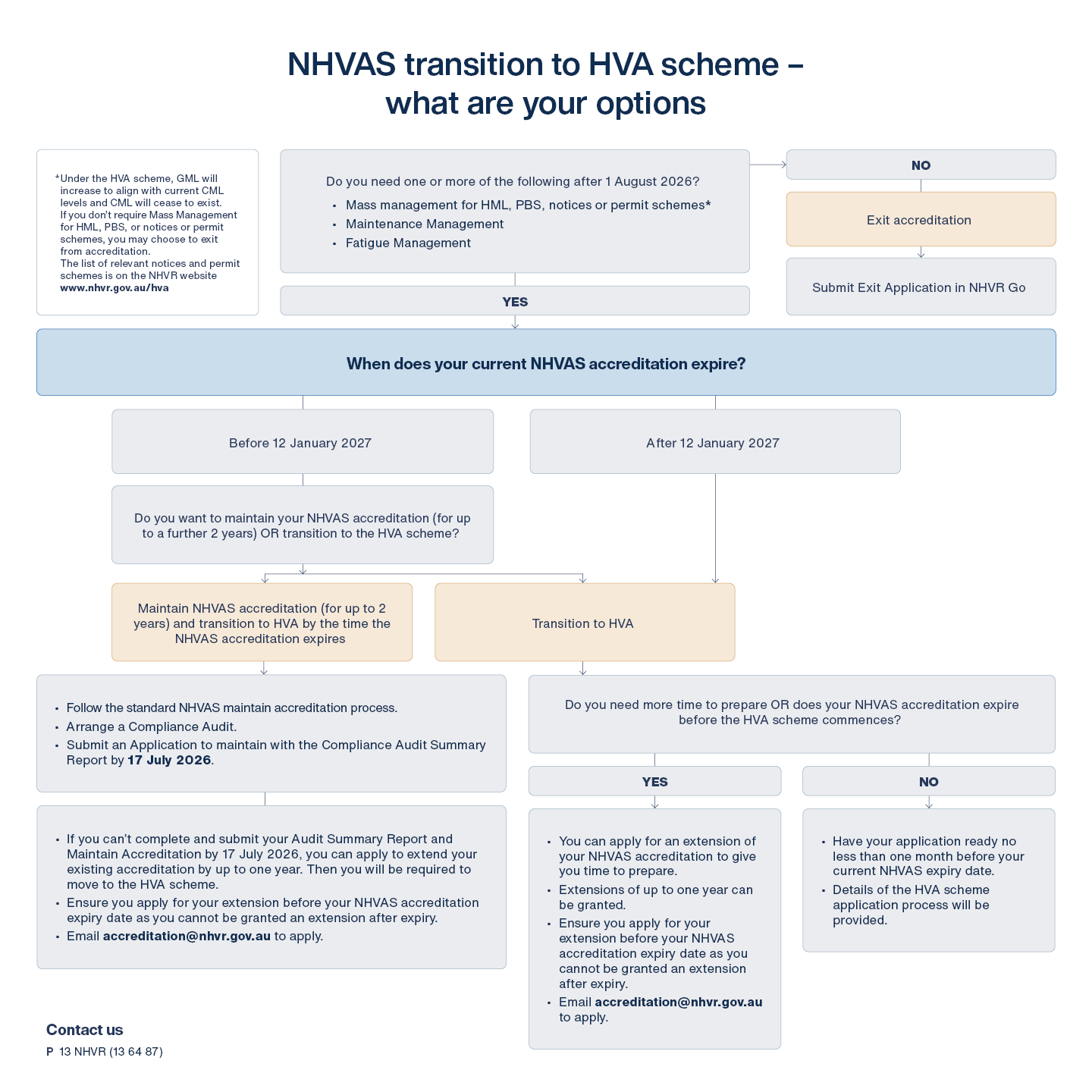
NHVAS transition to HVA scheme - what are your options flowchart (PDF, 139KB)
Case study examples
The NHVR will manage a phased transition approach to ensure existing NHVAS operators have time to prepare for the new HVA scheme. This will allow industry to either maintain their NHVAS accreditation (dependent on expiry), exit, or request extensions where required to support transition (accreditation period can be a maximum of 3 years).
The case studies below outline the options for operators, depending on the expiry date of their NHVAS modules.
Case study example 1 – Mass Management and AFM accreditation expiry prior to 1 August 2026
Operator A currently holds NHVAS Mass Management and Advanced Fatigue Management (AFM) accreditation, which expires on 30 May 2026. They need Mass Management accreditation to continue using Higher Mass Limits in Victoria.
Operator A can continue operating under NHVAS as their accreditation expiry is prior to 1 August 2026, provided they comply with the current requirements to maintain NHVAS accreditation. They will need to complete a compliance audit and submit an NHVAS ‘maintain application’ to the NHVR no later than one month prior to their accreditation expiry, which for Operator A is 30 April 2026.
During this time, Operator A can prepare to transition to the new Heavy Vehicle Accreditation (HVA) scheme.
Case study example 2 – Mass Management accreditation and CML expiry prior to 1 August 2026
Operator B holds NHVAS Mass Management accreditation for the purpose of accessing Concessional Mass Limits (CML) only. Their accreditation expires on 20 June 2026. When the new Heavy Vehicle National Law (HVNL) commences on 1 August 2026, the General Mass Limits (GML) will be increased to align with current CML weights.
This means that Operator B will no longer require accreditation to access the CML weights after 1 August 2026.
Operator B will be required to submit an‘Exit mass management application’ in NHVR Go. At the same time, they can also apply to the NHVR for an extension of their Mass Management accreditation to cover the period between the expiry of Operator B’s accreditation and the new law taking effect.
Case study example 3 – Mass Management and BFM accreditation expiry after 1 August 2026
Operator C holds NHVAS Mass Management and Basic Fatigue Management (BFM) accreditation that expires on 15 January 2027. They have decided to move to the new HVA scheme when their current accreditation expires, but only for Alternative Compliance Accreditation (ACA) – Fatigue, because they do not require Mass Management accreditation for any notices or permits.
Operator C will apply for General Safety Accreditation (GSA) and ACA - Fatigue at the same time. They will select the most suitable BFM-equivalent work and rest template from NHVR Go, which provides predefined work and rest hours.
Operator C commenced the transition process early (prior to expiry) but later identified the need for additional time to finalise the process. They can apply to the NHVR for an extension of their NHVAS BFM accreditation and ensure they retain their existing concessions until they have been granted HVA scheme accreditation.
Operator C creates an ‘establish accreditation application’ in NHVR Go and completes the auditor request, which includes selecting an HVA Approved Auditor, an audit date, and audit location/s. Once the audit date and location/s are accepted by the auditor, the application is reviewed and approved by the NHVR, and the audit proceeds. The completed audit report, including a statement from the auditor confirming that the Safety Management System (SMS) complies with the SMS Standard, has been uploaded to the application in NHVR Go. The application is then submitted for assessment by the NHVR.
Case study example 4 – Maintenance Management accreditation expiry after 1 August 2026
Operator D currently holds NHVAS Maintenance Management accreditation, which expires on 3 September 2026.
Operator D would have received notification from the NHVR that they could elect to maintain their NHVAS accreditation as their accreditation expires before mid-January 2027. To maintain their accreditation, they will need to complete a compliance audit and submit an NHVAS ’maintain application’ prior to 17 July 2026.
Once Operator D’s ‘maintain application’ has been assessed and approved, their NHVAS accreditation will be maintained. During this time, they can prepare to transition to the new HVA scheme prior to the expiry of their NHVAS accreditation.
Case study example 5 – Maintenance Management and BFM accreditation differing expiry dates
Operator E has NHVAS Maintenance Management and Basic Fatigue Management (BFM) accreditation. Their Maintenance Management accreditation expires on 23 September 2026 and BFM expires on 15 January 2027.
Operator E would have received notification from the NHVR with the option to maintain their NHVAS accreditation, as their Maintenance Management accreditation expires before mid-January 2027. In this situation, where the current NHVAS accreditation modules have different expiry dates, Operator E has two options.
Option 1: Move the BFM accreditation expiry date to align with the Maintenance Management accreditation and maintain NHVAS
Operator E can contact the NHVR to request that their BFM accreditation be aligned with the expiry date of their Maintenance Management accreditation, which expires on 23 September 2026. Once the request has been assessed and approved, Operator E will complete a compliance audit and submit an NHVAS ‘maintain application’ prior to 17 July 2026.
Option 2: Maintain the Maintenance Management accreditation until the BFM accreditation expires, then transition HVA
To maintain their Maintenance Management accreditation, Operator E can complete a compliance audit application and submit an NHVAS ‘maintain application’ prior to 17 July 2026.
Prior to the expiry of their NHVAS BFM accreditation on 15 January 2027, Operator E can prepare to transition to the new HVA scheme. Note that both Maintenance Management and BFM accreditation will need to be transitioned to the new HVA scheme on expiry of the BFM accreditation.
Case study example 6 – Applying for new accreditation after 1 August 2026 while operating under NHVAS
Operator F is accredited under NHVAS for Maintenance Management. They decide to remain in NHVAS until their accreditation expires in February 2027. In September 2026, Operator F decides they want to add Basic Fatigue Management (BFM) to their accreditation.
Because the HVA scheme has now commenced, Operator F cannot add BFM to their NHVAS accreditation. Operator F will need to transition to the new HVA scheme and can select Alternative Compliance Accreditation – Fatigue. Templated work and rest hours will be available for industry to access, and Operator F can select a BFM equivalent work and rest option.
Operator F will need to transition their Maintenance Management accreditation to the new HVA scheme at the same time. If Operator F needs more time to transition to the HVA scheme, they can apply to the NHVR for an extension of their existing NHVAS accreditation for a period of up to 12 months (Note: The accreditation period cannot exceed a maximum of 3 years from the original date of accreditation being granted).